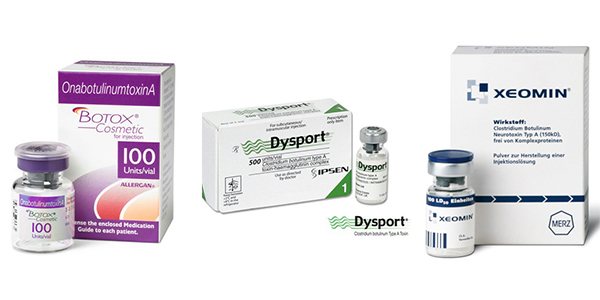
Botox, Dysport and Xeomin are all derivatives of the Botulinum Toxin Type A protein. Commonly referred to as ‘Botox’, this procedure has been a mainstay for cosmetic medicine for over 20 years. More than 20 million Cosmetic Botox procedures have been performed with the rate of treatment growing by around 20% each year. The reason Botulinum Injections are so popular is their ability to correct and prevent facial wrinkles and deliver a very natural looking result. Regular botulinum injections are still the best way to delay the ageing process.
Botulinum injections work by blocking neurotransmitters that stimulate muscles to contract. When we create facial expressions, we are contracting muscles. Over time, this produces wrinkles. Botulinum injections reduce (or even prevent) the muscle contractions that cause wrinkles. The side-effect profile of botulinum toxin type A is very good with Botox being regularly administered to children as young as 2 in doses up to ten times more than what is commonly used in Cosmetic Medicine; to treat muscular disorders and spasticities.
The difference between ‘good botox’ and bad botox’ is the practitioner’s ability to place the botulinum into the correct muscle with the correct dose in accordance with the individual anatomy they are addressing. This is the ‘artistic’ side of Cosmetic Medicine and often what differentiates one practitioner from another. Dianna is a former employee of Allergan, the makers of Botox, and is trained to the highest level in the use of Botulinum.
BOTOX® is a prescription medicine containing 100 units of clostridium botulinium type A toxin complex for injection. It is used for the treatment of severe frown lines associated ‘crow’s feet’ around the eyes and wrinkle removal. It should be administered only by trained medical professionals. Talk to your specialists about the benefits/risks of this procedure in appearance medicine. Caution people with neuromuscular transmission disorders, presence of infection at site of injection, pregnancy and lactation. Possible side effects include headaches, pain, burning sensation or redness at injection site, temporary local muscle weakness including eyelid droop, decreased sensation and nausea. If you have side effects or concerns, talk to your doctor. A charge applies. Allergan New Zealand Pty Ltd, Auckland. Note: Botox® treatment lasts about four months and after this time further courses of Botox treatment may be necessary. Talk to your Auckland Botox specialist about the benefits/risks of this procedure.
DYSPORT® is a prescription medicine for the treatment of frown lines, horizontal forehead lines and crow’s fee round the eyes. Dysport® has risks and benefits. Ask your doctor is Dysport® is right for you. If you have side effects see your doctor. You will need to pay for Dysport®, and clinic fees will apply. For details on precautions & side effects consult your healthcare professional or the Consumer Medicine Information (CMI) at www.medsafe.govt.nz. Dysport® lasts about 4-6 months and further courses of treatment may be necessary. Should only be administered by trained medical professionals. Contains 500 units of clostridium botulinum Type A toxin. Galderma (NZ) Limited, Auckland.
XEOMIN® (Incobotulinumtoxin A) 50, 100 Units is a Prescription Medicine. Indications: In adults for the treatment of cervical dystonia; blepharospasm; spasticity of the upper limb; upper facial lines: glabellar from lines, lateral periorbital lines (crows feet), horizontal forehead lines. Xeomin® has both risks and benefits, consults your doctor if Xeomin® is right for you. Further information on the risks and benefits of Xeomin® can be found in the Consumer Medicine Information (CMI) available from www. medsafe.govt.nz or by calling 0800 822 310. Use strictly as directed. If symptoms continue or you have side effects, see your doctor, pharmacist or health care professional. Common side effects include: Headaches; nausea; tenderness, swelling, redness, numbness or bruising of the skin; dry eye; heavy feeling or eyelid/eyebrow/forehead; face/brow not symmetrical. dropping eyelids/eyebrows. Serious side effects are rare and include allergic reactions. XOEMIN® is an unfunded medicine, prescription charge will apply. Normal doctor charges will still apply. Medical information: Ph 0800 822 310. Copyright 2021. Pharmacy Retailing NZ Limited t/a Health Care Logistics (HCL) 58 Richard Pearse Drive, Mangere, Auckland 2022. All rights reserved. Xeomin® and Merz Aesthetics are registered trademarks of Merz Pharma MGMbH & Co.